
About us
The Centre for advaNced Optical Microscopies (cNOM) is a facility aimed at improving the accessibility of both “work-horse” and cutting-edge optical microscopes for measuring various samples, including living cells.
The centre was formally established in 2022 at the Jožef Stefan Institute (Ljubljana, Slovenia) based on over 20 years of expertise in optical imaging of the Laboratory of Biophysics, Humar Lab, the Department of Molecular and Biomedical Sciences, and the Department of Biotechnology. We are a part of SiMBioN (Slovenian Consortium of Infrastructure Centres dealing with biomedical and biochemical imaging) from 2026; membership of Euro-BioImaging pending.
Our equipment and services
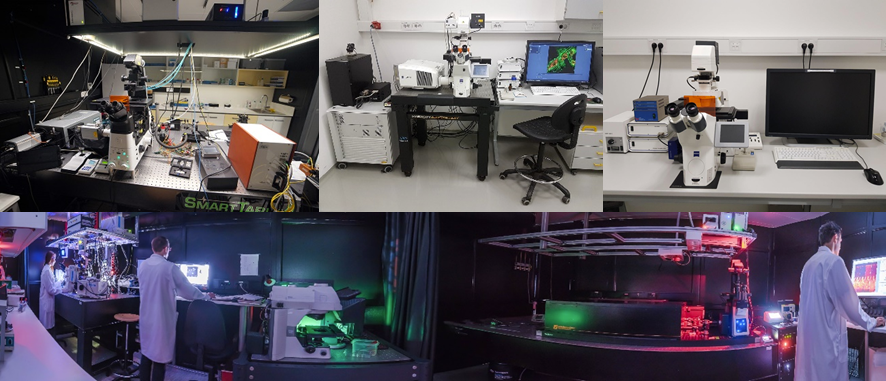
We offer access to multiple advanced and high-throughput optical microscopes, including “work-horse” microscopes with large fields of view, state-of-the art super-resolution STED, multi-photon, FLIM, spectral imaging, wide-field super-resolution SIM, quantitative phase imaging, 2.5D microscopy, ….
Most of the microscopes are automated and use an auto-focus to enable operator-free multi-day measurements. Several of them have been automated in-house using Python, and can thus be upgraded to enable intelligent content-aware microscopy.
All of our microscopes are located in BSL1/BSL2 certified laboratories and are equipped with stage-top incubators with CO2-, temperature- and humidity-stabilised environment to enable long-term in vitro live-cell imaging.
Although the microscopes have been specially adapted for imaging living samples, they are commonly used on non-living systems as well.
We also offer expert guidance on sample preparation, imaging and image analysis, as well as hands-on training and collaborative support to both researchers and industry.
Why automated and advanced optical microscopies?
The reliability of conclusions from microscopy images requires capturing and analysing a large number of images, especially when observing samples with inherently large variability (e.g. biological samples). This process can be majorly streamlined and sped up by fast, automated microscopy.
On the other hand, the complexity of biological samples necessitates the use of complementary advanced imaging approaches – preferably simultaneously – which is enabled by multi-modal optical setups.
Importantly, non-invasive imaging of living biological samples in their native state and in real time enables unique and novel mechanistic insights through the direct observation of the complex dynamic biological processes, their spatial patterns, interactions, and their progression.